Cargo Bike

Years ago I built a front loader cargo bike with a bed the size of a sheet of plywood. It was awesome and easy enough to make. Here are photos of a more sensible replica.

Here is a link to the CAD file. I chose a mid BMX bottom bracket because they’re the only bottom bracket I can’t kill in a season, and BMX stuff is both inexpensive and durable. I run it single speed, with a coaster brake. It’s geared super low. Like 24 to 18 low. It’s about 4 feet wide outside the front wheels, so it’s basically a critical mass ride of one. It’s pretty great to haul all of our beach stuff and the kids to the beach too. I don’t know many other bikes that will carry a full cooler.

It has worked great since May. I started with a 26″ wheel on the back and broke spokes all the time because of the loading perpendicular to the plane of the wheel. Because it doesn’t lean into turns it’s loaded differently than a regular wheel. I changed to some kid’s BMX wheels with a coaster brake and had much better luck.

A lathe interlock story

Early in 2022, at work, we had a student throw a part out of a manual lathe because of difficulty with the lathe chuck. It’s an ongoing problem with new users really wanting to leave the lathe chuck key in the lathe chuck, and standardizing lathe safety training along with getting students to retain that training is a thorny problem.

So I thought I would try an engineering control, or implementing a safety interlock that would not allow the lathe spindle to be started while a chuck key is in the chuck. I had used a lathe with an interlock of this style and I thought it was a pretty slick solution. I measured the headstock and drew up some parts. Conveniently, the wiring for the emergency stop was just under a dust cover easily accessible to the front of the lathe. I drilled a hole there and placed a limit switch operated by the interlock. Here’s the first version. ( CAD Link )

This worked well for the use case I designed for – lathe with a chuck on it – but not perfectly for the lathes set up with collets.

Visibility wasn’t great because the collets don’t stick out as far as a whole three jaw chuck.

I didn’t think this was a problem, and my coworkers didn’t notice it, so it created a situation where the engineering controls made the user experience worse. I ended up with a version with a honeycomb of holes that stuck out from the headstock just enough to prevent the chuck key from being inserted. I’m pretty pleased with it. ( CAD Link )

3d Printed Drawer Latches

I have two small kids. I wanted to baby proof my kitchen drawers but didn’t want a bunch of adhesive garbage on them. I love designing flexures. So I made this drawer latch.

My drawers have 3/4 inch thick faceplates and the cabinet faces are also 3/4 inch. These work OK on doors but are a lot harder to open. With enough frantic pulling, the flexure legs will break in tension, but if you’re making these you can probably 3d print more.

Load cells with a Potentiometer and 3d Printer (and math!)


Update (08/02/20): PLA has really poor creep behavior, so these work great, but only for a week or so. After a month of use, I lost all of the throw on these flexures.  I still think this is a worthwhile project and if you’re not leaving a load applied on your 3d printed flexures, they’re still a great solution. I want to experiment with other materials or reinforced filaments, but that’s pretty far down my list at this time.

Original Post:

I am very slowly working on a self cleaning cat litter box. One of the problems with automating it is detecting when a cat has made a “deposit”. I initially thought that I could measure in increase in the weight of the whole litter box system. Now my thinking is to detect the increase in mass of the cat getting into the litter box and then leaving, since I don’t want to run the litter box with a cat inside. It also avoids needing precise calibration of the system weight.

My first thought on this was: “No Problem! I’ll just find some cheap load cells and go for it!” It turns out that “cheap load cells” are rare as hen’s teeth.

I needed a super inexpensive way of measuring force. Enter a flexure.  Flexures are awesome because they’re really easy to model with beam bending formulas that anyone can use. They also pair really nicely with a 3d printer and a parametric model. I had already built some flexure spreadsheets based on JPE Precision Point.

Flexures, spreadsheets, 3d printers, and parametric models are an amazing team. You can design your flexure for planned loads, displacements, and fatigue life in a spreadsheet pretty easily. My preference is to have a cell with the factor of safety calculated from the maximum moment and the thickness of the flexure blade with conditional formatting so I know my factor of safety stays above 2.  That lets me ignore fatigue life for most of the stuff I make.

Then you take those dimensions and put them in a parametric model like this one.

It turns a potentiometer via a live hinge in the model. I’m tempted to revise it to have the flexure push a gear rack that turns a gear on the pot, but this was also a fun case for a live hinge. It’s designed that way to make it easy to injection mold, or to make an extrusion in the event the market for custom made flexure scales takes off.

So all of that makes it possible to make a short throw scale that will turn a potentiometer to measure the load on a flexure. Neat!

A Stab at Public Art.

Some time prior to 2010, I met a woman at a bar in Wilkes-Barre, PA. I chatted her up, and asked what she did. She replied “I’m a sculptor.” Curious, I asked where I could see her work, because I assumed that any sculptor would have outdoor public work. She replied that she didn’t have anything showing at the time.  Intent on making an ass of myself, I then started boasting about a “public sculpture” that I helped to design and build.  It was this pink camouflage tank in Philadelphia. 2837234108_22fb71585c_oMarissa, (pictured) is not the sculptor in question.

This thing was part of the Kensington Kinetic Sculpture Derby, in May 2008. It was driven by six bicycle cranks on the inside, with a driver and a turret operator. It was very slow. More photos here.

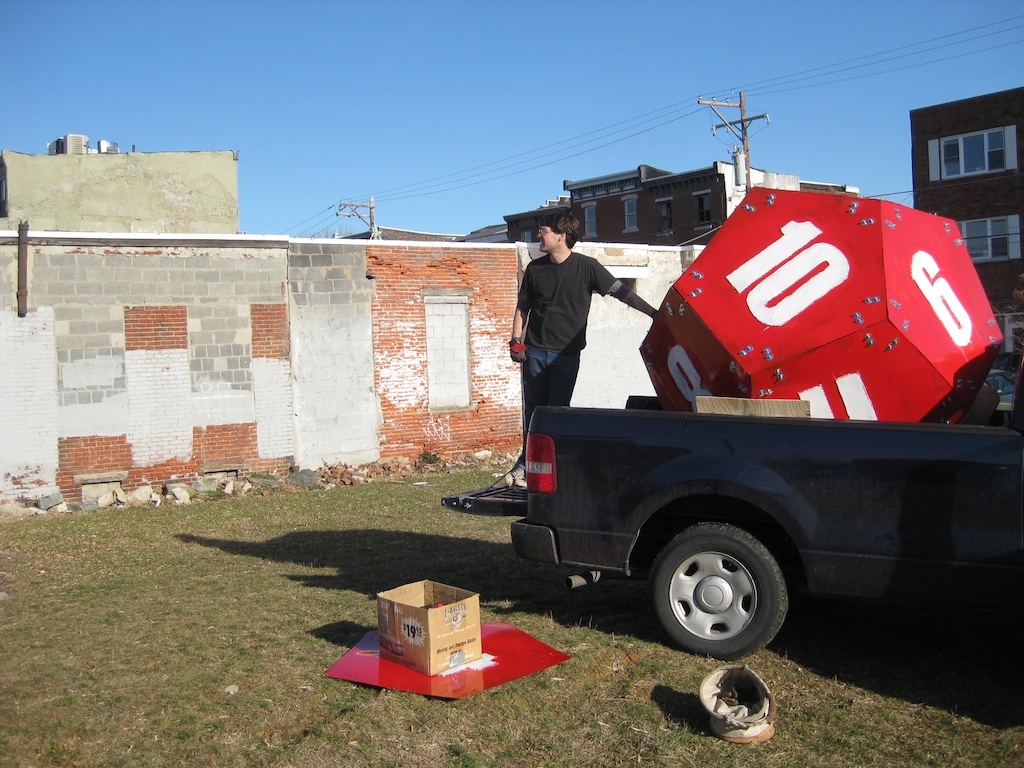
The lady from the start of the story and I went on to be good friends, despite my terrible manners. In the wake of our single abortive date, I decided that my claim to being a street art sculptor was too tenuous, and I designed and built this giant 12 sided die. I chose the 12 sided die because it was instantly recognizable to folks who had done role playing games, and because the twelve sided die is kinda useless in dungeons and dragons, as I recall. It’s in every drawstring velvet bag of dice, but you never really use it. It was also pretty easy to design, since all the panels are the same size and shape, and the angles between each planar side are equal.

4319044622_75e21b7274_oNot knowing anything about art, big/red/shiny was very much in earnest.

The 6 foot diameter 12 sided die lived in the sculpture garden on Frankford ave for a couple years. I believe the city cut it and the pink tank up because they were a drop point for local drug deals.

This project satisfied my desire to make public art, or to pretend that I was part of some kind of circa-2008 street art conversation. At this point, I’m not willing to inflict mediocre sculptures on the world without permission. Making giant silly stuff is really fun, but it takes up a lot of space.


All about Framebuilding Part 8: Resources (with commentary)

All of the knowledge in this series of posts was either stumbled upon by iterating on existing processes, or by learning from the Paterek manual and online resources.  This is a list of my favorite resources, with commentary.


Framebuilders email list:

https://groups.google.com/forum/#!forum/framebuilders

This email list waxes and wanes in popularity, but it is searchable in google groups.  Searching the archives is incredibly useful to see framebuilding experts including big names sharing useful knowledge.  This is a great first stop for any process questions.


Velocipede Salon:

https://www.velocipedesalon.com/forum/f14/?s=cec5dfe1b66f6560f4991e9214c5abe1

They have great ask-me-anything style threads with famous (for framebuilding) builders. They also have an index of useful tips and tricks. Highly recommended, not as easy to search as the framebuilders list.  Has more images than the text only framebuilders list.


Social Media:


Lots of builders document their work and workflow on instagram and post stuff on other social media.  I’ve gotten the most from watching instagram and keeping an eye on fixtures and setups.


Sheldon Brown

https://www.sheldonbrown.com/

Sheldon Brown has the kind of bike component technical resources that aren’t really found anywhere else. Lots of good stuff. I learned to build wheels from his post about wheel building.


Peter Verdone

https://www.peterverdone.com/

Peter Verdone has a lot of cool nitty gritty details about building bikes and being serious about mechanical engineering design.

All about Framebuilding Part 7: Finishing.

Once you’ve done all of the metalworking, it’s time to sand and polish your frame. There might be little lumps of filler metal from brazing, or stray file marks, or lumps in the castings of parts you’re using, or inconsistencies in the welding, etc.  All of these imperfections will show up through paint. If you care about those aesthetic considerations, any of those blemishes need to be blended out with sandpaper.


I like 1 inch wide rolls of sandpaper in varying grits.  They are nice because you can run them over the tubes in a shoe polishing motion, or wrap them around a file.  Be careful not to remove too much material by sanding. They smooth out the surface of the metal tubes by removing metal and it’s totally possible to sand right through the tubes.  Don’t create a thinner tube wall than you designed for by sanding too much.

This is particularly easy to do if you’re using sandpaper to smooth out fillet brazed joints.


There are a couple options for coating your frame:


Powder Coating.

Powder Coating uses electrically charged plastic particles to coat the metal frame, and then melts them all together in an oven.  Powder coat is more durable than wet paint, better for the environment, and almost as good looking. It’s also much less expensive and much less labor intensive.  It’s a common industrial process and most medium size towns will have a local powder coater. To get an idea of what colors are available, call your local powder coater.  You could also talk them into doing other colors.

Columbia Coatings and Eastwood sell DIY setups and materials for powder coating.  They are both good references for the colors available.


Automotive Wet Paint.

Automotive wet paint is also an option.  Talk to your local auto body shop and see what they can do.  Unless you want to seriously nerd out on painting, it’s very unlikely that you can do as nice a job as an automotive body shop at the same cost.

I have wet painted some motorcycle and scooter stuff, along with a few bike frames.  It requires control of the humidity in the atmosphere, scrupulous attention to detail, fastidious cleanliness, and a ton of sanding. Getting good at wet paint makes climbing the TIG welding learning curve look easy.


Spray Paint

This is the stuff you buy at the hardware store. Follow the instructions, use primer and a top clearcoat. It won’t be very durable, but you can do it in your garage.  Emptying a spray can releases lots of stuff you don’t want to breathe. Do it in a well ventilated area. I spray painted a lot of things in my parents’ basement when I was in high school.  It stunk up the whole house. I can’t believe they put up with it.


Spray.Bike

I haven’t used it, but it’s in rattle cans and marketed for coating bike frames.


Direct to Metal (DTM) Epoxy Paints

These are really durable coatings that you can apply with a brush. I rode two bikes painted with this stuff and while they weren’t pretty coatings, they worked great.

If you want to go for a post apocalyptic form follows function look, coal tar epoxy is a good option. It’s ugly, goes on with a brush, leaves brush marks, and doesn’t require primer.

All About Framebuilding Part 6: Braze Ons and Final Prep

Braze Ons are a catch all term for the extra little doodads that you attach to the frame.  They are typically attached by silver brazing. This is how cable stops, water bottle bosses, rack bosses, chain hangers, pump pegs, and so on are added to a steel frame.


I prefer to attach all of these little parts with clamps made from spring clamps. I bend chunks of welding wire and braze them onto spring clamps, then use the end of the wire to hold the braze on to the bike frame. This is a very rough and ready approach. There are a number of cool tooling options available.  Cobra Framebuilding and Sputnik Tool both sell clamps to attach braze ons.
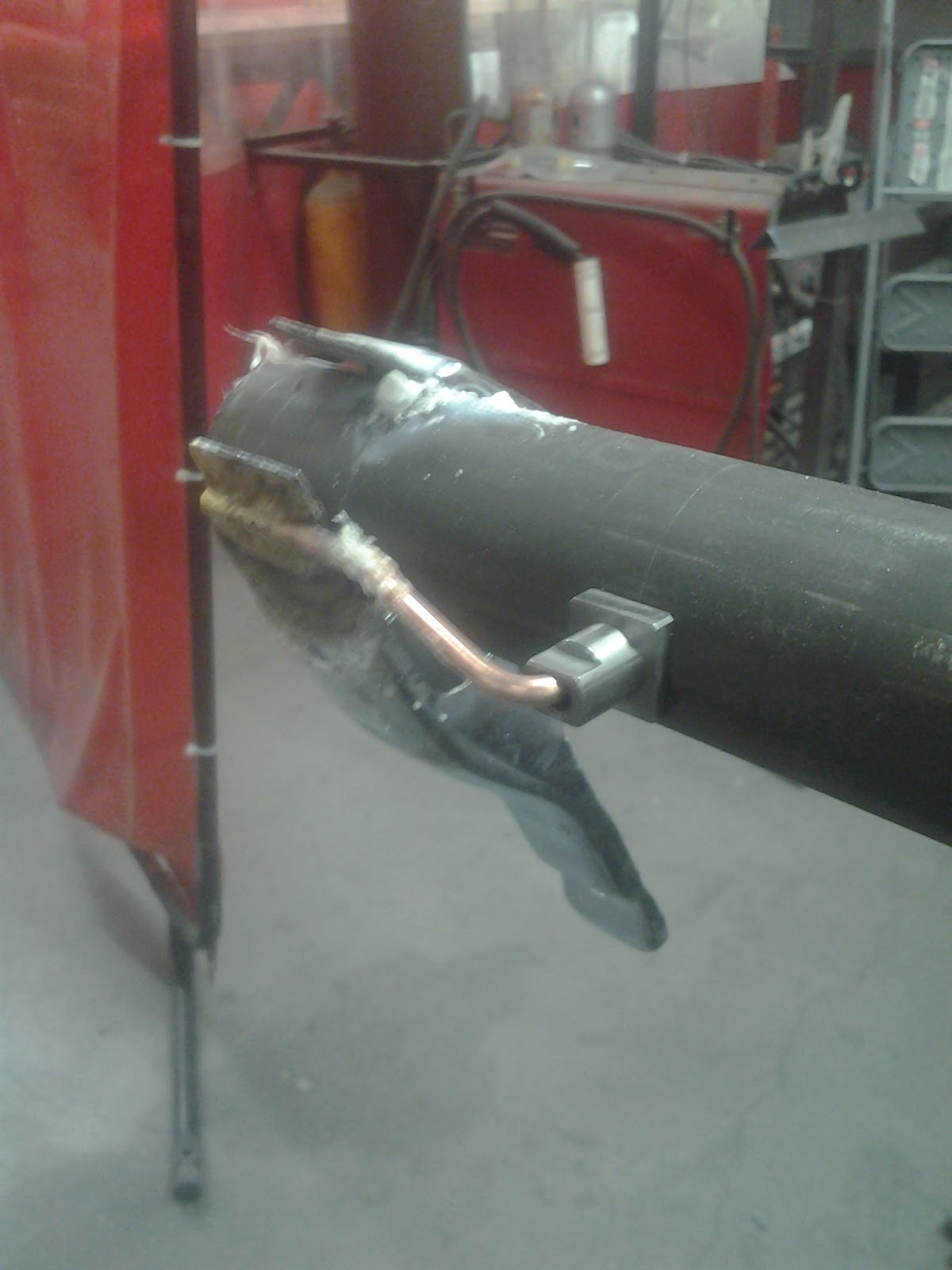
springClampBrazeOn


Braze ons are a really easy way to ruin a nearly finished frame.  Done improperly or attached at the wrong location, they can create a weak spot in the bike tube that can crack and ruin the bike. Worse yet, this crack can appear after only a month or two of use.  I attached downtube shifter bosses to one of the first frames I built up. I rode it back and forth to my day job, 15 miles each way. One morning, I started to hear a creak from my bike. I still had 4 or 5 miles to go, so I kept riding.  The frame started to feel a little looser as I approached work. When I arrived at the office, I noticed a spiral crack working it’s way around the downtube from the area right next to the downtube shifter boss. I had to take the train home that day.  When I cut out that section to fix the frame, I traced the crack to two sources. The downtube shifter boss was attached in the thinnest section of the tube, and I had brazed it on with bronze filler metal instead of silver solder. I don’t know which of these mistakes caused the failure, but I didn’t repeat either of them again.

If you’re going to braze on your braze-ons, use silver brazing. Attach your braze ons in the thicker butts of the tubing if at all possible.

Purists will clutch their pearls, but adhesives are a better way to go.  Metal to metal adhesives ( JB Weld is my favorite ) are very effective with proper joint preparation, and they will not ruin the strength of your tubes. They’re also easier to use than silver soldering, and require zero practice.


Even the low heat of silver brazing will cause some distortion of the tube shape, making the tube less round. This is more of a problem with TIG welding and fillet brazing. To make your headset, seatpost, fork crown race and bottom bracket fit properly, you’ll need to do some post welding machining. Most of this machining can be done with hand tools.  The easiest is the seat tube. Seat tubes need to be reamed in order to have the seatpost fit properly. The seatpost reamer allows the builder to remove just enough material so that the seatpost has a nice sliding fit with the seat tube. If the fit is too loose, the frame isn’t as strong and the seatpost clamp isn’t as effective. If the seat tube inside diameter is too small, the seatpost won’t go into the seat tube, or will be a super tight fit that’s likely to get stuck.

To ream the seatpost, put the frame in a repair stand, remove any removable seatpost clamp, and put some cutting oil on the seatpost reamer. Turn the reamer clockwise while pushing it into the tube. It will cut away a small amount of the inside diameter of the seat tube, so the seatpost fits just right.

Remove the reamer while continuing to turn in clockwise. Turning the reamer backwards will dull the cutting edges.


Reaming and facing the head tube is a similar process. It requires the right size reamers for your head tube and headset combination. If you’re using a press fit bottom bracket, reaming and facing the bottom bracket is the same.  If you’re using a threaded bottom bracket ( which you should!) chase the existing threads in your bottom bracket shell with a bottom bracket tap set.


Park Tool is the biggest manufacturer in the US of these tools. I’ve also used Cyclus tools and IceTools. It’s also possible to buy reamers in just about any size from your favorite machine tool supplier.


Cold setting and Frame alignment


Keeping weldments straight is by far the hardest part of welding stuff. Because of the heat in the process, there frame experiences local thermal expansion and contraction anywhere you heat it up. This causes the phenomenon known as welds “pulling.”

distortion B 06

Image from WeldingEngineer.com


Super tight joint fitup helps to mitigate this problem, but it’s still there.  Ideally, you’d check your frame on a surface plate at various points in the welding process to bend it back into alignment or go over your joints again with the welding or oxyfuel torch.  I have heard this referred to as “wizard wanding.” Manufacturers who need really flat weldments with minimal variation will go to great lengths to control those welding processes. They might have preset welder settings, super detailed instructions for how long any segment of weld can be, what order to weld each segment in, and so on. If you’re not already welding at a professional level, just go for it and accept that your frame is going to dance around a little bit.


There are tools to cold set dropout alignment and to check the frame alignment. Park Tool also sells a frame bending tool.  I’ve used it, it works. You may well need it for your first couple frames.