All About Framebuilding 5: Fixturing

This is where the rubber meets the road. Your tubes are filed, fitted, and ready to weld. You have you favorite welding or brazing setup. How to turn this pile of metal pieces into a component that you can bolt parts to?


Commercial Fixtures:


There are fancy commercial fixtures out there. Anvil, and Sputnik are the two big names that I’m aware of, though I’m sure there are more. These are sweet. They’re made for pro framebuilders who need serious efficiency.  I’ve never used one to build a bike, but I have met many builders who swear by them.


Mid range Commercial Fixtures:


Joe Bringheli sells some reasonably priced fixtures. I have met many hobby builders who have used his fixtures, and they seem great. It’s unclear to me how easy they are to set or how repeatable they are.


DIY Fixtures


I love solving meta problems. I’ll happily make tools to make tools to make tools. This is sometimes referred to as yak shaving.  With that in mind, I’ve made a number of iterations of DIY fixtures. My first one was a straight ahead Andrew Hague copy ripped straight from an illustration in the Paterek Manual.

diyFixture

This worked well, but was limited to fixed tube diameters.   Some might poo poo the square tube used, but they show up very straight from your local steel distributor and are very inexpensive. If you’ve done any other welding fabrication work outside of bikes, you know how nice square tube like this can be to use.


A couple iterations on this landed the design at the fixture in this rambling video, where I set it up.


CAD Files for the fixture Assembly


Around 2014 I was trying to sell tools like this in an ill advised business. While the business never really took off, it made me refine these tooling designs into a coherent system using 80/20 extrusions. 80/20 extrusions are nice because they require much less machining and they’re nice and straight and flat. They’re priced for business to business sales, but they also have an ebay store where they sell off surplus at very reasonable prices.

(I still need to gather up these designs and post links to the assemblies.)


A flat surface.


The basic building block of all these fixtures is a flat surface with standoffs of known length. If you have both of those things and the ability to make precise measurements over the distance of your frame, you might not need a fixture. It’s entirely possible to make a nice straight frame using some blocks, a flat surface, and lots of care.  A full scale drawing helps with this too.


In the machining industry, flat surfaces like this are ubiquitous for measurement. They are referred to as “Surface Plates.” Vendors like McMaster, MSC, Shars, and Grizzly sell them in varying sizes and flatness ratings.

In the welding industry, great big flat tables are really useful for exactly the same task as welding bike frames. Lots of stuff needs to be aligned to a plane and then welded. Acorn welding platens are the canonical table for this task. Sadly, they are no longer in business. Weldsale sells a similar table. I have used them and they’re really nice. There are a couple of options geared toward casual users. Stronghand tools has a nice cart with a flat plate top. Certiflat is another more DIY option.


I’m excited about the potential for 3d printed parametric models and single use tooling. Done well, you could make plastic alignment tools that would allow just about any joint configuration to be held securely and welded with much lower costs than all of the tooling listed above. Validating the results would require a surface plate or other measuring devices, but those precise measurement tools could be reserved for measurement, keeping them nice and precise.  Nothing ruins a cast iron surface plate faster than weld spatter.

All About Framebuilding Part 4.5: Brazing

Brazing works by melting a lower melting point filler metal between two pieces of parent metal. Typically the heat for this operation comes from an oxyfuel torch.


Any Oxyfuel torch is one of the oldest welding technologies (aside from a forge, which is much older).  It works by burning Acetylene in Oxygen. Acetylene is a common fuel that you can buy in compressed gas cylinders at your local welding supply shop.  That acetylene cylinder is deadly serious. Acetylene is so flammable that it can spontaneously detonate at pressures above 15psi. We need to store a lot of it, so it’s pumped into a cylinder that is filled with a calcium silicate sponge (like a synthetic pumice stone) that is then filled with acetone. The Acetylene is dissolved into the acetone, allowing it to be stored at pressures higher than 15psi.


Why is that important? If you draw off the acetylene too fast, some of the acetone will come out with it and damage all of the seals that keep the acetylene inside your regulators, hoses, and torch.  That’s bad news, considering that you have an open flame on the end of the torch. If you smell a garlic smell or the flame of your torch is purple, shut down your system IMMEDIATELY.


The other component of the system is a tank of oxygen. Oxygen isn’t flammable itself, but it makes everything else flammable. Either of these things leaking is a bad situation.


If you’re buying an oxyfuel rig to make bikes, do not cheap out on any part of the rig.  Buy a new, brand name torch setup with new tips, hoses and regulators. Install them on cylinders that you buy from a welding supply house that you go to in person. Buy the nicest cart you can stand to hold your cylinders.  If you keep your oxyfuel rig in nice shape, it’s very safe. Just about every automotive garage has one, and they almost never explode. Maybe don’t keep it in your basement.


To start up your oxyfuel setup, open the acetylene side and light the flame. There will be a sooty flame coming out of the torch. Open the Oxygen cylinder and adjust the oxygen regulator until you have a neutral flame.  You will have a neutral flame when the inner and secondary cones of the torch flame converge.


Image Credit: enginemechanics.tpub.com


When you are done using your torch, shut off the oxygen first, then the acetylene. Close the valves on both cylinders. Drain the system by opening the torch valves.  When the pressure on both sides of both regulators reads zero, loosen both regulator screws.


Brazing requires shaded eye protection, of at least shade 3. For some silver soldering, sunglasses are enough. Protect your vision with the appropriate shaded eyewear.


When torch brazing, both parts are coated with flux.  Brazing flux is an acidic paste that is tuned to melt at the right temperature for the filler metal to become liquid, and it’s acidity etches the surface of both metals to be joined so that the filler metal molecules can penetrate the surface of the parent metal. It’s important to use fluxes that are made for your filler material.  I have experience using gasflux products, and have been happy with their performance.  Cycle Design is another popular brazing supply company. I’m told their stuff works well.


In practice, here’s how it goes: Make sure everything is clean before applying flux. You liberally apply flux to all the areas you’d like to braze together. If they have a close fit like a sleeve or a lug, apply flux to both parts separately and assemble them wet. Once they’re assembled, put on your shaded eye protection and light the torch.  Adjust the torch to a neutral flame, and work it over the joint until the flux becomes clear and liquid. At that point, the joint is nearing the brazing temperature. Once the parent metal is hot enough, touch it with the filler metal. The filler metal should melt freely and smoothly wet out over the surface of the parent metal. There should not be any fuming or sizzling. If the filler makes any sizzling or popping noises, the joint is too hot. Let it cool off, clean up the burned flux, and start over. This will happen a lot as you’re learning to braze.

If you’re brazing a sleeve or a lug, you can pull the filler metal through the joint with heat and capillary action. The front of the filler metal will follow the heat of the torch. With practice, you will be able to pull molten filler metal from one side of a joint to the other to know that you have a completely brazed joint. If there are any globs of filler metal, those are areas where the joint was not hot enough or did not have enough flux.


Once the joint has cooled, there will be a clear crust of hardened flux over your brazed joint.  This flux can be difficult to remove without hot water. I like to keep an electric tea kettle in the shop and pour the boiling water over the brazed joint.  It heats and dissolves the flux, which is the only way to go vs trying to mechanically remove it.

All about Framebuilding 4: Tube Joining and Mitering

Now that you’ve designed your dream frame or copied a bike you like, It’s time to actually join the tubes. There are three main options: TIG welding, Fillet Brazing, and silver soldering. You could also bond them with adhesives I guess.


A quick aside – Most of what I know about material science.


    Metals are nice to design with because they have nice, uniform material properties. That means that given consistent geometry, they’re equally strong in every direction. These properties come from the alloy composition of the material. The alloy composition is the mix of atoms of different elements that are in the metal. For example 4130 steel contains :


Component   Wt. %

Carbon     (C)  0.28 – 0.33

Chromium     (Cr) 0.8 – 1.1

Iron         (Fe) 97.3 – 98.22

Manganese     (Mn) 0.4 – 0.6

Molybdenum     (Mo) 0.15 – 0.25

Phosphorus     (PMax) 0.035

Sulphur     (SMax) 0.04

Silicon         (Si) 0.15 – 0.35


That’s a lot of elements. It’s interesting that we call 4130 ChroMoly for Chrome and Molybdenum, but they only make up a maximum of 1.36% of the material by weight.


For a given material composition, there can be a range of material strengths that are based mostly on the grain size of the metals. In cast metals, the grain sizes are at their largest and the material is at its lowest energy state. That’s because the grains have lots of time to shed heat and kinda relax into great big grains. As the material is worked or heat treated, the grains of the metal get broken into smaller pieces, which are stronger. This is why forgings have superior material properties to castings. When you weld two pieces of metal together, the area next to the weld will be the weakest part of the joint.  This is due to two factors: You (almost always) add material when welding, so the weld itself is thicker. The weld filler metal is often a different alloy than the parent metal, and it’s designed to be strong without additional heat treatment. The area right next to the weld doesn’t get any extra metal but it does see all the heat. This area is called the heat affected zone, and it ends up being the weakest part of the joint because the parent metal gets annealed. This is why destructive weld testing requires that the weld be stronger than the parent metal. The weld has a built in advantage of strength and would be a really poor quality weld to break before the parent metal.


OK – that’s almost everything I know about materials science.


Done properly, silver soldering and fillet brazing will not anneal the tubes of your frame, so you get all the material strength of the tubes. TIG welding will always create a heat affected zone, because the metal becomes liquid, which is by definition above the annealing temperature. Modern tube alloys designed for TIG welding will retain their material properties if they aren’t excessively heated.  I believe they’re called air hardening. For a comparison of materials within one brand, check out this Reynolds design guide. How much heating is excessive? I’m not sure, because I’m not a materials scientist. Shoot for the narrowest heat discoloration from TIG welding and you should be OK.


The safest way to join your tubes is with lugs and silver soldering. Lugs are those fittings between the tubes on cool old bikes and Rivendells. Lugs are great because they constrain the angle of the two tubes and they allow you to join the tubes with silver solder. Silver solder is basically metal glue that creates a metallurgical bond between the three pieces of parent metal(s).  It also has a melting temperature that is below the annealing temperature of the tubes you’re using. That means that the tubes won’t be weakened by the heating of silver soldering. This process is also called silver brazing. The two terms are used interchangeably.

Lugs are also sometimes a hassle because they constrain the angle between the two tubes being joined.  That means that if you need half a degree of adjustment, you might be out of luck, or you might need to bend the lug.

Lugs are also a neat way to get really artistic with your frame, as you can file and shape them to be cool and frilly with lots of embellishment. I’m not crazy about the amount of handwork this requires, so I tend to avoid it.


One nice trick with lugged joints is the ability to pin them.  This acts like a tack weld or braze, but you can take it apart. Miter the ends of your tubes and dry fit the lugs.  You can do this in a fixture or relative to your flat surface. If you’re using a full scale drawing, then you can put the whole frame on top of the drawing to make sure it’s the right size and shape (I call this “looking like the picture.”)  At this point, your lugged frame is just the right geometry, and it would be really nice if it stayed there, except that you have to pull it all apart to coat everything in flux, which you probably don’t want to drip all over your full scale drawing or nice reference flat surface.

How to solve this problem? Pin the lugs. Use an automatic center punch to make a divot so your smallish drill bit doesn’t walk, and then drill a hole through the assembled lug and tube.  Then you firmly but gently drive a tapered pin into the hole, and it creates a reference feature that will lock the alignment. You can take the pin out, pull everything apart, slather flux all over it, reassemble and re-pin, and everything will be in the right place.  A side benefit is that the pins can help to mitigate distortion from the heat of brazing. Even though you’re not melting the metal, it still expands and contracts with temperature. There are a couple options for this, Cycle Designs sells a kit with instructions.  Another solution is borrowed from assembling machine tools and uses tapered pins like these from McMaster.   Over the lengths formed by the combination of the lug and tube, a single drill hole is adequate. If you wanted to really go overboard, the tapered pins from McMaster are sized to be used with tapered pin reamers.


Fillet brazing is a nice middle ground for joining bike tubes.  It’s not very difficult, allows any joint angle you want, and is very strong. It requires more finishing hand work than tig welding, but is much easier. Fillet brazed joints are typically sanded smooth on custom bikes. This has the benefit of hiding imperfect brazing technique. If you’re like me and you don’t like hand sanding stuff, practice until your brazes look like a clear coated Brompton. Donezo.
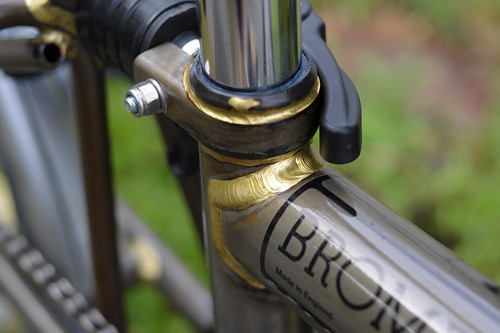
Photo credit: Lovely Bicycle


Tig welding is the most flexible way to join bike tubes.  It’s also the most dependent on operator skill. (That means it’s the hardest.) TIG welding is the most portable skill for other fabrication, and if you’re only going to buy one welder, it should be a TIG welder. Done properly TIG welding adds the least filler material and requires the least post weld handwork.


MIG welding

Wait, but I thought there were only three?!

MIG welding is super easy. It’s probably possible to make a workable bike frame with one but you’d have to use the thinnest wire and probably use heat sinks. If you do this, all the other bike builders will make fun of you. That might be a mark in the positive column. (?) It’s also a recipe for chasing a hole in thin walled tubing all along the length of the tube.


Tube mitering:


The most important part of welding is joint preparation. Good fit up sets you up for good welds and straight frames. That means the ends of your tubes need to be just the right shape, oriented properly, and the right distance from each other.  I’ve probably thought about this problem more than any other fabrication task. Here are some of the ways to go about it, roughly ordered from lowest tech to highest tech.


  1. File the ends until they’re the right shape.

Pros: Very flexible, inexpensive. You only need a file.

Cons: hard to control, takes forever. Repetitive motion injuries? Good way to cut your fingers.


  1. Use printed miter templates and a hacksaw / file.

Pros: Very flexible, inexpensive. Much easier than eyeballing it. Allows you to measure between mitered joints.

Cons: Drawbacks of hand filing. With practice, takes about 5 minutes per tube end. Good way to cut your fingers.


  1. Use 3D Printed File guides

Pros: Very flexible and inexpensive. Easier to measure between mitered joints than paper templates. Easier to keep in phase than paper templates.

Cons: Drawbacks of hand filing. Requires a 3D printer. 3D printing is slow.


  1. Commercial hole saw setups

    Pros: Nice, cylindrical cut.

Cons: Easy to kink and destroy bike tubes with off the shelf hole saws. Hard to control feedrate. Can leave a nasty burr. Can be difficult to keep centered. Poor resolution on angle setting. Poor control of notch to notch distance.


  1. Hole saws in a bridgeport

Pros: Nice, cylindrical cut. Gives you an excuse to buy a Bridgeport

Cons: Bridegeports are expensive, heavy, and hard to move. Takes up a lot of space. Tooling can be expensive or must be custom made.

  1. Abrasive mitering 

Pros: Nice, cylindrical cut. Better surface finish and size control than hole saws. Sandpaper is much less expensive than hole saws.

Cons: Smells bad. Ruins machine tools used for it.

  1. Laser cut tubes

Pros: Effectively perfect joints. Someone else does it.

Cons: May require CAD models. May be difficult to source in small quantities. Depending on how you measure cost, expensive. Someone else does it.

  1. Custom Hole Saw fixtures.

Pros: nicely controls angles and tube lengths

Cons: Cost. Requires hole saws.

All About Framebuilding 3: Design Tools

For your first bike, copy a bike you already like. Just about every manufacturer publishes the geometry for each model and size, so it’s pretty straightforward to copy.


Once you’ve decided to make something that you can’t buy, BikeCAD is the way to go. It’s a bargain at $500 (Canadian!). That’s under $400 US at the time this was written. BikeCAD has libraries of most commercially available parts, and it will create mitering templates to cut your tubes.


RattleCAD is an open source alternative to BikeCAD. I have used it a couple years ago and I liked how fully featured it was. I found it less user friendly than BikeCAD, but it may have improved in recent versions.


If you already have a favorite CAD software like Solidworks or Fusion360, just use that.


When I made my first frame, I built a spreadsheet based on the Paterek manual that would calculate all of the lengths and miter angles for me. I used this in combination with this tube coping calculator. Tim Paterek published the first edition pdf of his manual on his website, but it seems to be down as of 2020.


For the true retrogrouch, there’s always the option of making a full size drawing on a big piece of paper.  This has the benefit of working nicely with the build method of laying out all your parts on top of your 1:1 scale drawing. It’s a lot harder to revise than a CAD model though. If you really must do this, at least make a spreadsheet to do all of your fit calculations. I’ve made a couple full size drawings just for laughs and it’s super satisfying but not when you have to do it over again and again and again. There’s also the option of having a full scale drawing printed.  Even in 2019, there are still printing businesses for blueprints, because they’re still used in the construction industry. A sign printing business could potentially do this too. The blueprint businesses will be able to reliably print to scale. Signmakers are more of a gamble. If I were going this route, I’d make some reference features of known size on my drawing so I could quickly check the scale when I received the drawings from the printer.


A couple notes on safety:


Product liability follows you forever. Even if the end user abuses or misuses your product. If you’re going to sell (or even give?) bikes to other humans, you should carry insurance and do the stuff that the insurance company requires you to do. After making a bunch of bikes, I wish I had cut more of them in half once I had ridden them.  That’s not because I’m ashamed of them, it’s because my name was painted on the side and now they’re in the hands of who knows who. I’m responsible to those mystery third parties for bikes that I have no control over. Insurance is expensive, around $2000 per year around 2015.


Making your own vehicle is amazing. I encourage it, that’s why I wrote this. Be cautious about what happens with stuff you make, because it could get real expensive.

All about framebuilding Part 2: Materials

You’re building a steel bike with cheap tubes, because it’s a first try (if it’s not the first, you can call it an “early prototype”). Here’s a list of resources.

Tubes:

Make your first frame from straight gauge tubes. Fancy bike tubes are butted, which means they have thinner walls in the middle for weight savings and thicker walls on the ends for weldability. Those tubes are nice, but you want basic tubes, that have the same wall thickness all along their length. What you want is 4130 seamless tubing.


4130 tubes are sold by outside diameter and wall thickness. Bike materials are typically specified in millimeters, but aircraft materials are specified in inches. Some units back and forth may be required. 1 inch = 25.4mm.


Here’s a chart with common outside Diameters and wall thicknesses.


Tubing OD (mm) Tubing OD (in)
25.4 1.000
28.6 1.126
31.7 1.248
34.9 1.374
38.1 1.500
42 1.654
44.5 1.752
Seat Stays OD Seat Stay OD (in)
14 0.551
16 0.630
17 0.669
19 0.748
Chain Stay OD Chain Stay OD (in)
22.2 0.874
24 0.945
28 1.102
Wall Thickness Wall Thickness (In)
0.5 0.020
0.6 0.024
0.7 0.028
0.8 0.031
0.9 0.035


Here are some online vendor options:


McMaster. I could go on all week about how great McMaster is. They have everything you want for making stuff out of metal. They have great customer service and will sell small quantities. They have a reputation for being expensive, that isn’t always true at those small quantities.


Aircraft Spruce – They sell stuff to build airplanes. Some of that stuff is 4130 tubes.


Wicks – They also sell stuff to build airplanes. Some of that stuff is 4130 tubes.


Online Metals – The name says it all. They have 4130 tubes too.


Everything Else:


These vendors have brazons, dropouts, and other small parts.  If you must use butted tubes, they have those too.


Nova Cycles Supply – They have lots of good stuff and will sell framebuilding kits along with individual tubes. I’ve done a lot of business with them over the years and they’re good folks.


Henry James – They also have lots of good stuff and will sell kits along with individual tubes. Their braze ons, lugs, and other misc doodads are nicer than than the Nova ones.


Joe Bringheli – Bringheli is great, a super old school DIY framebuilding source.  I’ve ordered from him a number of times and it’s always a good experience.


Richard Sachs – Richard Sachs is awesome, and his stuff is top quality. Probably not a great choice for a first frame, but worth mentioning.


Paragon – Paragon Machine Works sells all the dropouts, brazeons, and other doodads you want. They have all the parts you want except tubes.
Torch and File – They sell Reynolds tubes and have some super nice tools.

All about Framebuilding Part 1

6903408676_df150f84f4_o

First off, this article series  (Book?) is about hobby building. It’s intended to share what I learned over a number of years of hobby frame building and some commercial framebuilding (that was really just hobby building with much higher costs.)


No one believes that their first frame will be trash. I didn’t when I built my first frame. Embrace the fact that your first frame will be trash. Give that trash a hug! Buy extra tubes ( or better yet, but straight gauge tubes). Copy an existing design.


Why copy an existing design?

If you’re enough of a bike nerd to want to build your own frame, you probably have an older steel bike that you like and are familiar with. Copy this frame. Copy this frame because you already know you like it. Frame design and geometry is a guessing game until you’ve made a number of frames in your size and then ridden them. You might also have a complete set of components for that old steel frame. If you copy it, you can move all of the components over to your new handbuilt frame and ride it. Chances are that you’ll love your new frame just because you made it, even though it’s a piece of crap. Embrace this bias and ride the wheels off of your new shitbox. Then break it down, build the original older steel frame back up, and realize that your first frame was inferior to the old production donor frame in every way.


Why a steel frame?

Steel is the easiest bike frame material. It’s light, strong, easily weldable, easy to braze, has a long fatigue life, and it’s inexpensive. If steel was invented tomorrow, the inventor would get a Nobel prize the next day.


But what about [some other material]?

New high end bike frames are made of carbon fiber. If you’re insistent that only carbon fiber will do, you should go to Dave Bohm’s school in Tucson. (Hat tip to Dave Bohm for getting framebuildingschool.com )

Aluminum frames require welding, and post weld heat treatment. Also, welding aluminum is less forgiving than steel because of aluminum’s reactivity with oxygen and other contaminants, not to mention that you have to go a lot faster. It’s doable, but is a level 2 ( maybe 5?) skill. Heat treatment for 6000 series aluminum requires high temperatures that you can’t do at home and 7000 series can be hard to source for the little bits unless you also have a machine shop to make aluminum in any shape you want.

Titanium frames require professional quality welding and fastidious cleanliness. Titanium is also a much more expensive material. I’ve never built a titanium frame because I never had the money to buy the tubes and a TIG welder at the same time.


What kind of frame?

Your first frame should be as simple as possible. A track frame is ideal, even if track bikes are a little silly. A road frame also makes sense. A rigid mountain bike frame is also good. Single speed bikes are a great choice. Also, Single speed bikes are rad. You should make one so you own one and ride one.

DIY Air Bearings with Graphite

Hackaday recently posted about DIY air bearings here and here. Lots of good stuff in there, from lapping the graphite in to discussions of the stiffness of the bearings around the 3 minute mark in the next video.  Air bearings are nice because they give all of the benefits of hyrdrodynamic bearings without the oil mess, and they’re self cleaning because they push contamination out of the beaing.


I also found this nice explainer of types of air bearings at Specialty Components, and this nice breakdown of design considerations for air bearings at IBS Precision Engineering.